

Powering Your Bird: The Ultimate Guide to Receiver and Servo Batteries
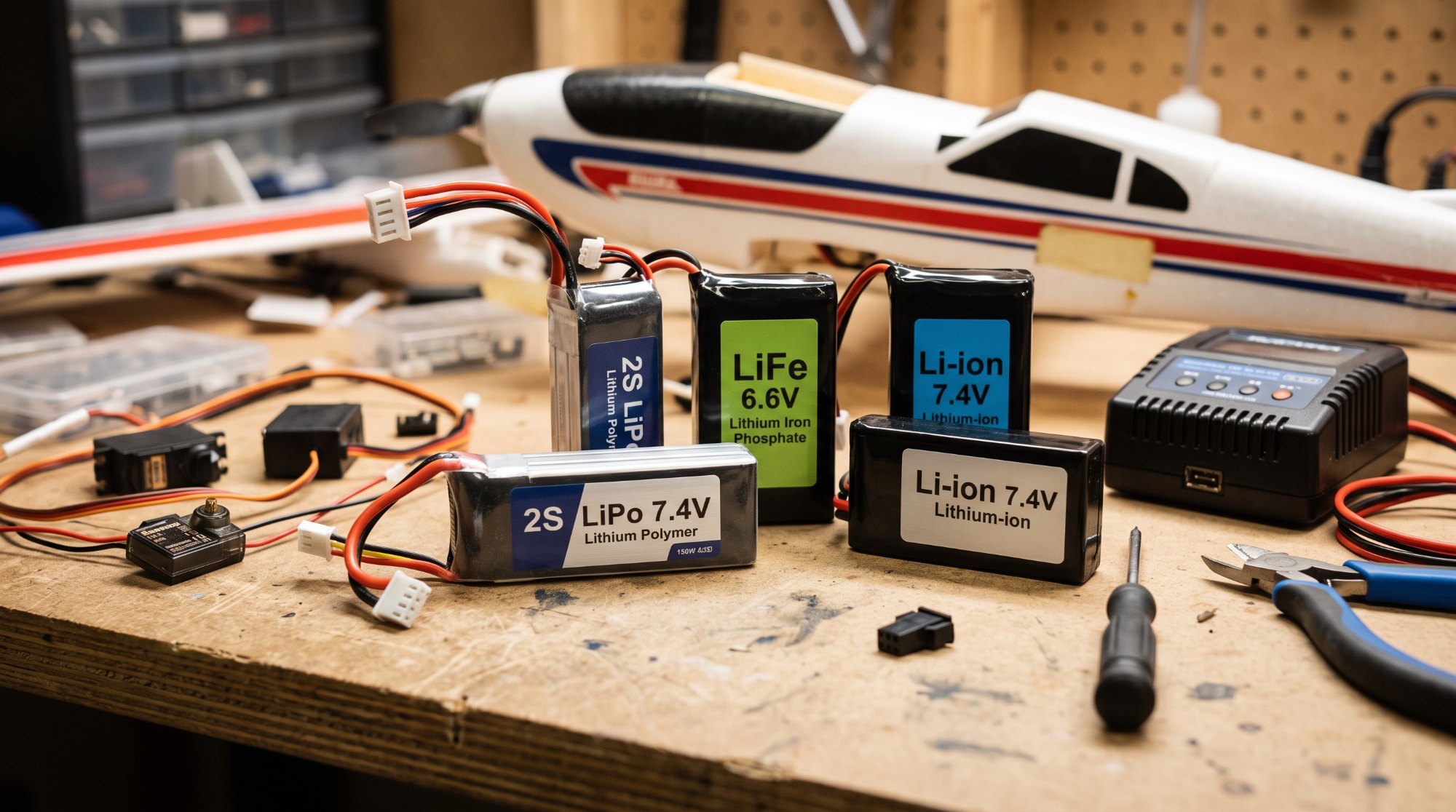
Choosing the right onboard power source is critical. Let's explore the pros, cons, and best use cases for LiPo, LiFe, and Li-ion packs.
For RC airplane and jet enthusiasts, an interruption in power to your receiver and servos means a total loss of control, transforming a prized model into an expensive, unguided projectile. Modern lithium-based chemistries offer high capacities, lighter weights, and steady voltages. But which one is right for your aircraft?
1. LiPo (Lithium Polymer)
Nominal: 3.7V/cell (7.4V 2S)
Max: 4.2V/cell (8.4V 2S)
Pros
- Incredible power-to-weight ratio.
- Extremely high discharge rates (C-ratings).
- Prevents high-torque servos from starving for current during aggressive 3D maneuvers.
- Available in almost any shape and size imaginable.
Cons
- Requires "High Voltage" (HV) capable servos/receivers, otherwise a regulator is mandatory to prevent burnouts.
- Strict care required; poses a fire hazard if damaged, over-discharged, or stored improperly.
Best for: Large scale aerobatic planes and giant scale jets equipped with modern HV servos where maximum speed, torque, and response times are demanded.
2. LiFe (Lithium Iron Phosphate)
Nominal: 3.3V/cell (6.6V 2S)
Max: 3.6V/cell (7.2V 2S)
Pros
- The "sweet spot" voltage: Operates safely with 95% of standard "6V" rated servos without needing a voltage regulator.
- Exceptionally safe chemistry; vastly lower risk of thermal runaway.
- Very flat discharge curve.
- Do not degrade as quickly when left fully charged.
Cons
- Slightly heavier and bulkier than LiPo.
- Flat discharge curve means standard voltage checkers are useless for determining remaining capacity. You must track mAh usage via charging.
Best for: Standard/large-scale warbirds, scale planes, and sport flyers using standard-voltage servos who want a safe, "plug and play" battery.
3. Li-ion (Lithium-ion)
Nominal: 3.7V/cell (7.4V 2S)
Max: 4.2V/cell (8.4V 2S)
Pros
- Superb energy density (massive capacity in a compact, lightweight package).
- Rugged metal-can cells (like 18650s) are physically tougher than soft-pouch LiPos.
- Extremely low self-discharge rate.
Cons
- Lower discharge rates (C-ratings); voltage may sag under massive rapid current draws.
- Like LiPo, unregulated 2S Li-ion requires High Voltage (HV) capable servos.
Best for: Long-duration flight setups, endurance models, and applications where raw capacity is preferred over peak burst current.
What About BECs?
Instead of a dedicated receiver battery, many electric (EP) flyers use a Battery Eliminator Circuit (BEC) integrated into the Electronic Speed Controller (ESC).
Pros: Shaves off weight; you only have one flight battery to charge.
Cons: If your main flight pack fails, or if the ESC burns up, you lose all control of the aircraft. Generally discouraged for large, expensive models.
Quick Comparison Guide
- Type · Nominal / Max Voltage · Need Regulator? · Ideal Use Case
- LiPo (2S) · 7.4V / 8.4V · Yes (Unless HV) · High-performance 3D, giant-scale aerobatics.
- LiFe (2S) · 6.6V / 7.2V · No · Standard sport, warbirds, safe & simple operation.
- Li-ion (2S) · 7.4V / 8.4V · Yes (Unless HV) · High-capacity, endurance flights, tight spaces.