


End of napkin math: smart scoring wins
A Guide for RC Contest Directors & Club Officers
For the past two decades, I’ve watched our hobby’s events hew toward “relaxed fun fly” events with “pilot’s choice” type awards and raffles for merchandise. Bucking that trend, I offered friendly competition at HeliStorm 2025 and was pleasantly surprised when 24 of our registered pilots stepped up to compete in 4 different flying categories. And, despite high winds, pilots put their big birds in the air to show off their skills. When awards came out, everyone knew that those awards were earned and not won through luck or a popularity contest. Witnessing that made me wonder why more events don’t have relaxed flying competitions at their events.
At every single fun fly I have attended, there are pilots who love to show off their skills. Why not reward that? Why not encourage other pilots to become better so they can compete? If you don’t like the pressure, don’t enter the competition — just fly. But when events have competition, EVERYONE gets interested quickly. Fans, pilots and competitors all get geared up and more engaged. Can mere mortal volunteers pull off judging along with all the other stuff they do? You might be surprised to learn that a new app makes it easier for contest directors and better for pilots.
The "Friendly" Competition Trap
We’ve all been there. It’s Saturday afternoon at the field. The energy is high, the flying is spectacular, and the event is billed as a "Fun Fly with Friendly Competition." Then comes the awards ceremony. A volunteer with a clipboard creates a bottleneck. There’s a frantic search for a calculator. Someone notices that Judge Bob gave everyone a 20 out of 20 on "Realism," rendering that category useless. A pilot asks why they got second place, and the only answer is, "I think the math worked out that way?"
Here is the hard truth: There is no such thing as a "friendly" scoring error.
Even in low-stakes events, pilots pour hours of wrenching and practice into their aircraft. When the scoring is sloppy, it devalues that effort. A sensible, transparent rubric doesn't make an event "too serious"—it makes it fair. It honors the pilot's dedication by ensuring the results actually reflect what happened in the air. But, hosting an event with competition brings additional challenges to an already overloaded contest direct. This is why I created LiveJudge. LiveJudge takes your scoring criteria and transforms it into a simple, intuitive scoring interface that judges can bring up on their own devices.
The Paper Trap: Why "Scales" Are Failing You
For as long as they've been held, RC contests have been run on paper scorecards that look like complex tax forms. They typically rely on variable scales to create importance.
- Takeoff: Scored 1-10
- Flight Realism: Scored 1-30
- Landing: Scored 1-5
The Problem: This forces the judge to do mental gymnastics. When a judge looks at a landing, their brain naturally thinks, "That was pretty good, maybe an 80%." But then they have to translate that: "Wait, the landing is out of 5... so is 80% a 3 or a 4?" This cognitive load leads to what is called scale compression. Judges get scared of the math, so they just give everyone a "safe" middle number (like 3 out of 5), and the scores bunch up.
 The LiveJudge™ Shift: The "Volume Knob" Method
Modern digital scoring systems (like LiveJudge) flip the script. Instead of changing the scale (1-10 vs 1-30), we change the weight. In this system, every single slider is 1-10. Assume there are only three judging factors:
- Takeoff: Judge slides the "score" slider to 8/10.
- Flight Realism: Judge slides the "score" slider to 8/10.
- Landing: Judge slides the "score" slider to 8/10.
- The Magic: The software handles the "Volume" knob for each judging factor.
- You tell the software that Takeoff is worth 10% of the score.
- You tell the software that Realism is worth 50% of the score.
The judge doesn’t need to know that Realism is "more important." They just judge the quality of the maneuver. If the Realism was an 8/10, they enter 8. The software automatically amplifies that score because it has a "louder volume" (higher weight).
Why this wins:
- Speed: Judges develop muscle memory. 10 is always perfect, 1 is always a crash.
- Accuracy: A judge can easily differentiate between an 8.5 and a 9.0. It is much harder to differentiate between a 3.5 and a 4.0 on a smaller scale.
Even More: Giving Judges a Roadmap (Multiple standards per judging factor)
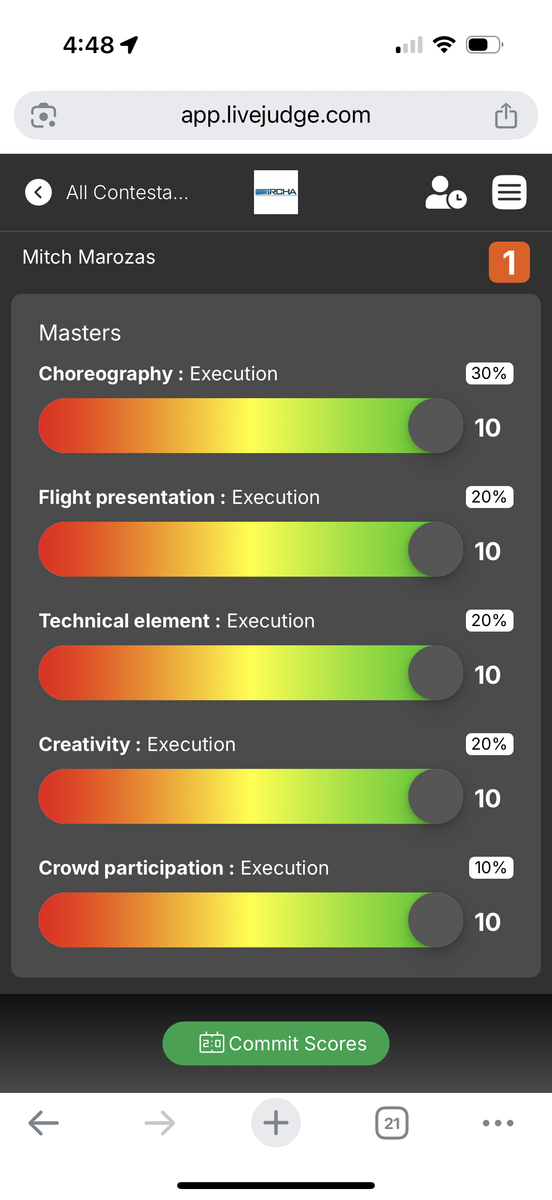 On paper, you might have a single judging element that encompasses multiple elements (like "landing"). The pilot flies a great approach but bounces the landing. The judge stares at the box. "Uh... 7?" Digital rubrics allow you to break that single "factor" into multiple "standards" without creating extra work.
Factor: Landing
- Standard 1: Turn to Base (1-10)
- Standard 2: Final Approach (1-10)
- Standard 3: Touchdown (1-10)
This gives the judge a roadmap. They don't have to guess the total value; they just rate the three elements they saw.
The Pilot Benefit:
Instead of seeing "Landing: 7.5/10," the pilot gets much greater detail: "Turn to base (9/10), final approach (9/10), but you bounced the landing (5/10)." That is actionable feedback they can use to improve their flying. The math gets computed instantly so in this case, out of a possible 30 points (10 max per standard), the pilot received a 23. That equates to a 76.6% (same score, better detail). Having this level of transparency cuts off protests and disgruntled competitors while giving spectators a realtime look at what is happening (like the Olympics).
The Difficulty Dial: Rewarding the Risk/Challenge
In one scoresheet I saw, every pilot was given the same "K-Factor" (difficulty) score for each maneuver. Mathematically, this renders the K-Factor meaningless. A K-Factor is a bonus multiplier designed to reward pilots who fly more complex variations on maneuvers or completely optional maneuvers.
- Pilot A flies a slow, gentle circle. It is technically "perfect."
- Pilot B attempts a wildly complex 3D maneuver but has a slight wing wobble on exit.
If you only judge execution, Pilot A wins. But Pilot B had to apply much more skill and should be rewarded, even though his execution was not perfect. This is where Difficulty Multipliers come in.
In LiveJudge, the Head Judge assigns a multiplier to the maneuver.
- Pilot A: Execution = 10 times Difficulty 1.0 = 10.0 Pts
- Pilot B: Execution = 8 times Difficulty 1.5 = 12.0 Pts
This mathematical lever ensures that a "perfect easy" flight doesn't automatically beat a "good hard" flight. It encourages pilots to push the envelope, knowing the system respects the challenge and risk.
Conclusion: Put the Calculator Away
We run RC events because we love aviation, not because we love data entry. Moving your contest’s rubric into a digital environment isn’t about being "fancy"—it’s about respect. It respects the judges by giving them a simple, consistent 1-10 toolset. It respects the pilots by giving them fair, weighted scores with detailed feedback. And most importantly, it respects the organizer by eliminating the hours of manual tabulation.
Stop scoring on napkins. Let the software do the math so you can get back to the flight line.