
The Brains in the Frame
A modern helicopter has fewer parts than you think. Know what each one does and setup stops being a mystery.
The Signal Path
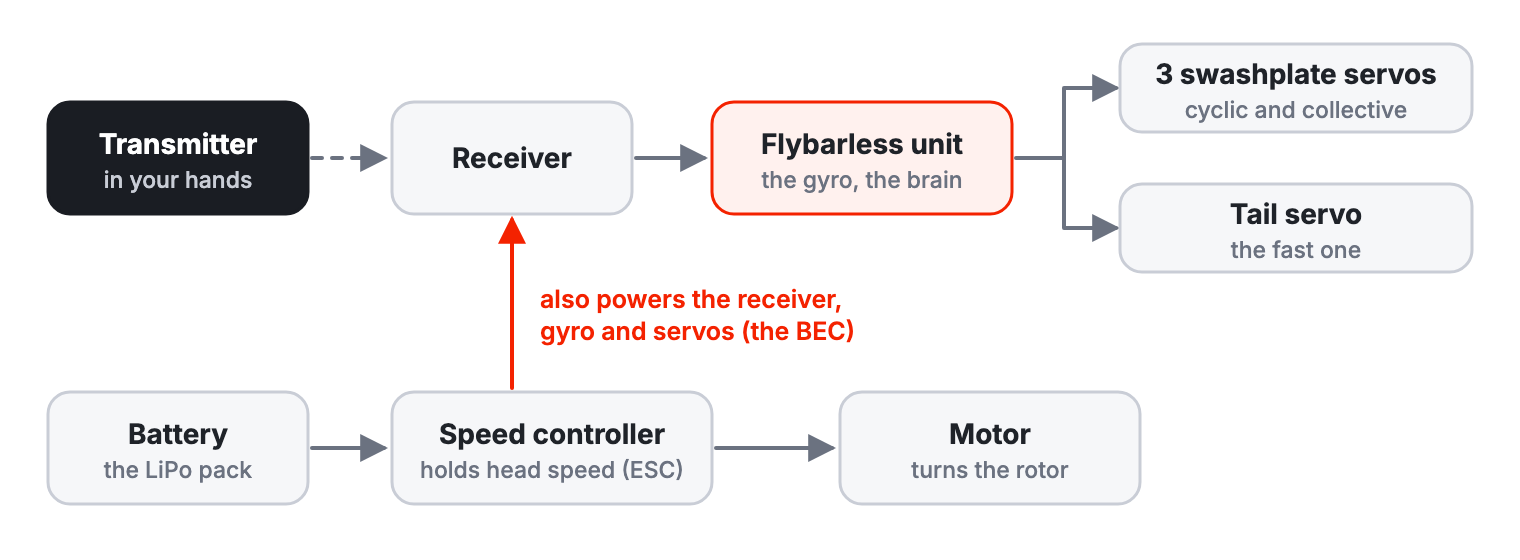
Your sticks talk to the receiver. The receiver talks to the flybarless unit. The flybarless unit talks to the servos. The ESC runs the motor. That's the whole show.
The Flybarless Unit
This is the brain. Its gyros stabilize the head and the tail constantly, which is why a modern heli can fly without the old mechanical flybar. Many units add a rescue feature that levels the helicopter on a switch. Pick one that is easy to program and that the pilots near you already know.
The Servos
Three on the swashplate for cyclic and collective, and one fast one on the tail. This is not where you save money. A cheap part in the control chain can destroy an expensive model.
The ESC
The throttle for the motor. A good one governs head speed, starts the rotor softly, and powers the receiver and servos through a built-in BEC. On a larger machine, think about a backup for that receiver power. The choices are laid out in Powering Your Bird.
Setup Is Everything
Electronics cannot fix a bad mechanical setup. In this order:
- Servo arms at 90 degrees, links the same length.
- Swashplate level.
- Zero pitch at mid stick, and the same pitch on every blade.
- Blades balanced and tracking.
- Then, and only then, tune the gyro.
DON'T GET LAZY and count on someone else to do this. Learn it. The lightbulb goes on once you sit down with the machine. Be Unfazed by Phasing and the Rotorhead Setup course are written around scale machines, but the physics is the same.