
Free Lift
A glider's real engine is the sky. The trick is getting up to where the lift is, and then reading the air once you are there.
What Keeps It Up
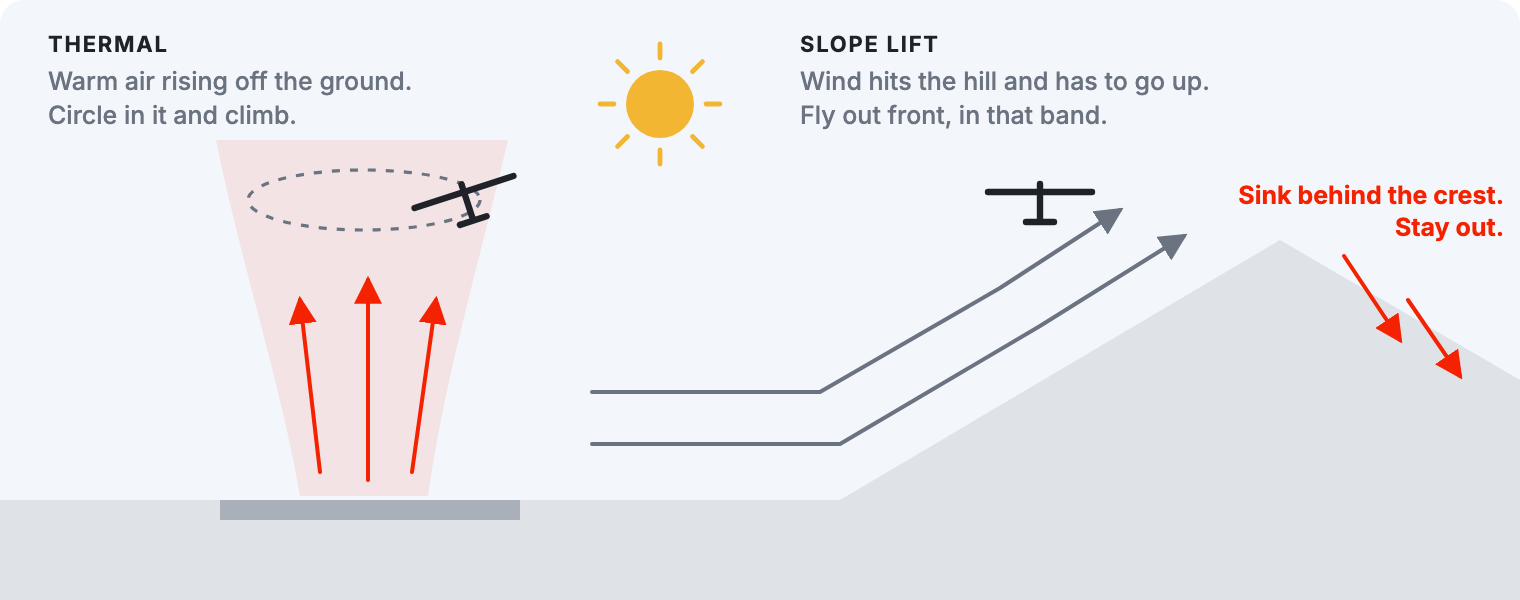
- Thermals: bubbles and columns of warm air rising off the ground. Circle in one and the glider climbs.
- Slope lift: wind hitting a hill has to go up. Fly in that band and you can stay up as long as the wind blows.
Everything else is just a way to get to the lift.
Ways to Get Up There
- Electric motor with a folding prop: the easy way, and the place to start. Climb, shut down, soar. Climb again when you need to.
- Hi-start: a long piece of rubber and line staked to the ground. A giant slingshot.
- Winch: a powered drum and line, for bigger and faster launches.
- Discus launch: your arm. Spin and release.
- Aerotow: a powered tug pulls the sailplane up on a line, like the full size ones.
- A hill: throw it into the wind and you are flying.
The Electric Setup
A small brushless motor, a speed controller with the brake turned on (that is what lets the prop fold), and a modest LiPo, often 3S. You use the motor for seconds at a time, so one pack can last a whole afternoon.
Finding Lift
Watch the glider. A wingtip that kicks up was just bumped by rising air on that side. Turn toward it. Watch the birds, too. A hawk circling without flapping has already found your thermal for you.
Respect the LiPo
Small packs still burn. Never charge unattended, store at storage charge in something that will contain a fire, and retire any pack that puffs. Read Are You Safe From Your LiPos?
