
The Brains in the Belly
Open the canopy on any scale helicopter and you will find the same handful of boxes. Know what each one does and the wiring stops looking like spaghetti.
The Signal Path
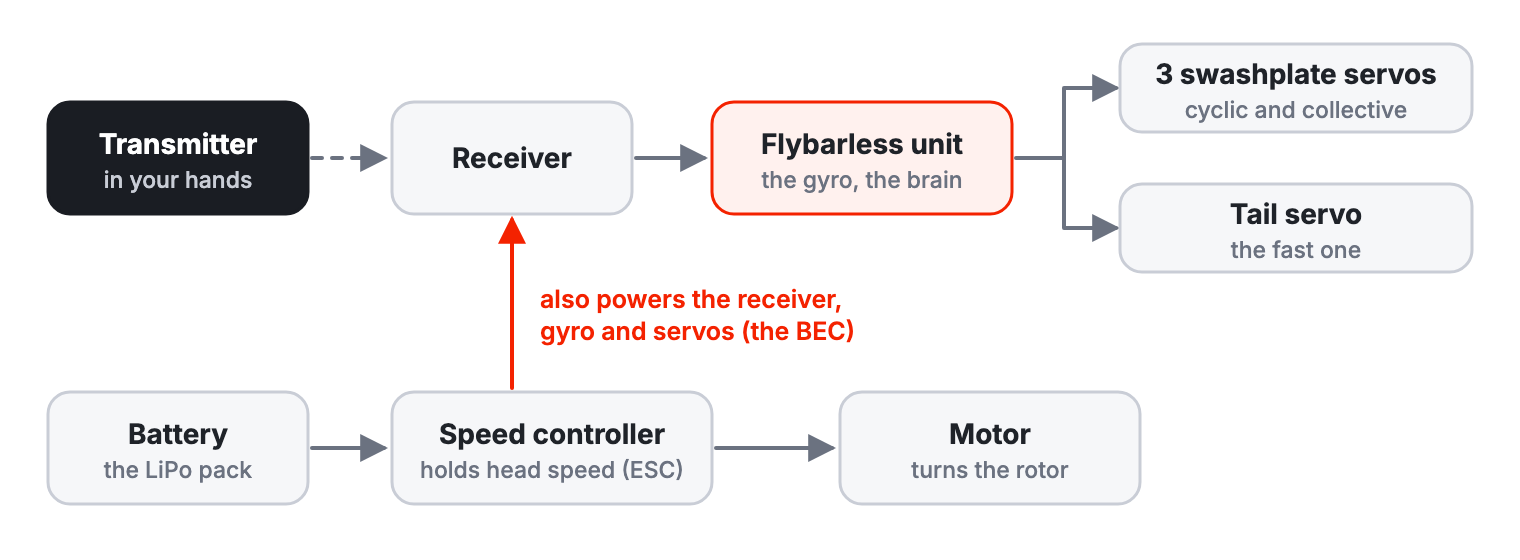
Your sticks talk to the receiver. The receiver talks to the gyro. The gyro talks to the servos. On an electric bird the ESC runs the motor. That's the whole show.
The Gyro
A flybarless (FBL) gyro is the brain. It stabilizes both the head and the tail, constantly, so the bird flies like a helicopter instead of a cat waking up in a circle of cucumbers. Get one that is easy to program. My favorite is the Bavarian Demon Axon, and I wrote down how its settings affect flight in AXON Gyro: Demystifying Setup.
A trick I wish I had figured out on my own: after the initial setup, HOLD the gyro in your hand and tilt it as if the helicopter were moving. Watch the swash correct the right way. It beats trying to tilt a big model on the bench.
The Servos
Three move the swashplate (that's your cyclic and collective) and one moves the tail. This is not where you save money. A cheap part in the control chain can destroy an expensive model.
The ESC
It is the throttle for an electric motor. A good one also governs head speed, so the rotor holds its rpm as the load changes, and gives you that slow, scale spool up.
Power for the Receiver and Servos
You have two choices. A BEC built into the ESC saves weight, but if the flight pack or the ESC quits, you lose all control. That is why it is generally discouraged for large, expensive models. The other choice is a separate receiver pack. Which chemistry, and whether you need a regulator, is all in Powering Your Bird.
Setup Is Everything
Electronics cannot fix a bad mechanical setup. Blade balance, pushrod geometry, phasing and tracking come first. DON'T GET LAZY and count on someone else to do this. Learn it.
- Be Unfazed by Phasing
- Let This Concept Resonate With You (ground resonance)
- The Rotorhead Setup course further down this page
Lights, sound, retracts and winches are the fun part. Add them after the bird flies well, not before.


