
MD500E Vario Turbine Build
 Rob M.

Head Speed Math with ChatGPT
October 17, 2025
Futzing around with ChatGPT to see what it knows about heli aerodynamics.
I was considering bumping up my head speed a little on TIKI to gain a bit more authority and reduce my hover pitch.
From ChatGPT:
"What about torque as it relates to the tail rotor? Is the increase in tail rotor speed a net gain in anti-torque effectiveness in spite of the extra force required to maintain the higher head speed rpm?"
Short answer: yes—your anti-torque margin improves.
Here's the scaling when you go from 1072 → 1179 RPM (ratio r=1.0999):
Tail rotor speed rises by r. For the same tail-pitch, tail thrust ∝ωt2/t, so available anti-torque at a given pitch goes up by r2≈1.21 ⇒ +21%.
Main-rotor torque to be countered changes much less. In hover, total power goes up ~10–13% (profile ∝r3 induced ~constant). Torque T=P/ω, so: Tnew≈1.10–1.131/.0999≈0%–+3%.
(Induced torque actually drops ~9% with higher RPM; profile torque rises ~21%. Blending typical model-heli fractions yields ~+1–3% net torque.)
Net effect: Available tail anti-torque (at a given tail-pitch) increases ~21%, while the torque you must cancel is ~+0–3%. So you gain roughly ~18–20% more margin before running out of tail authority.
A few practical notes:
- Expect snappier yaw response; you may need to reduce tail gain a touch to avoid oscillation.
- Tail power draw for holding the same torque rises about in proportion to tail RPM (~+10%), even though required thrust is similar.
- Check tail blade tip speed / noise and bearing loads—everything spins faster.
Using your MD500E specs, here's a solid hover power estimate.
Assumptions used (from your data + standard rotorcraft formulas):
- Weight: 40 lb (≈ 178 N)
- Main rotor: R = 0.875 m, 5 blades, chord c = 0.046 m, 1072 RPM
- Air density: ≈ 1.15 kg/m³ (≈2200 ft density altitude)
- Section drag Cd0 ≈ 0.012 (typical for RC rotor airfoils)
- Tail rotor + controls overhead ≈ 15% of main rotor power in hover
- Drivetrain losses ≈ 10%
Disk/rotor numbers (so you can sanity-check):
- Disk area A=πR²≈2.41 m²
- Solidity σ=Nb·c/πR≈0.084
- Tip speed ΩR≈112.3×0.875≈98.8 m/s
Power components (hover):
- Induced power Pi=T·√(T/2ρA)≈1,009 W
- Main rotor total Pmain≈1.34 kW
- Tail rotor allowance (~15%): ≈ 1.54 kW
- Drivetrain losses (~10%): ≈ 1.7 kW
Bottom line (hover at ~2200 ft DA):
≈ 1.6–1.8 kW (about 2.3 hp) to sustain hover, given your RPM and geometry.
Comfortable hover & maneuvering: target ~3–4 kW continuous capability (gives headroom for gusts, turns, and mild climb rates).
Aggressive climbs/aeros: brief 5–6 kW burst capacity is a good safety margin.
(Suggested simply flying it at both RPMs to see the difference)
But I need to know the WHY it works... or doesn't :)
October 18, 2025
(Asked what the data would be used for)
TL;DR summation:
The questions for ChatGPT:
1. What is the cost of pushing the extra RPM?
2. How much more lift would it get me?
3. Would the extra tail speed be a net improvement, a loss or a wash?
4. Would it reduce my hover pitch by much?
5. How many watts does my system currently need and how many with the change of RPM?
6. Is the PRO5000 up to the task?
Answers:
1. Minimal
2. About 12-18%
3. Net improvement.
4. Pitch reduced by about 0.5 - 0.7 degrees
5. 1.6–1.8 kW to sustain hover.
6. The Jakadofsky PRO5000 is more than adequate.
ChatGPT recommended a motor rating of 3–4 kW continuous. Aggressive climbs/aerobatics would need a 5–6 kW burst capacity for good safety margins.
The Jako PRO5000 is rated at 5200W. I don't do aggressive/high collective climb outs or aerobatics so I don't expect to push that 5200W rating.
EXPANDED Section:
So, some curious elements to my TIKI build:
- Vario lists a head speed of 1004 for their 1/5 MD500 with their 870mm x 44mm blade set.
- I currently run at 1072rpm as this was the closest gearing I could get using the Heliclassics mechanics and the Jakadofsky... Mathias seemed surprised I wanted it this low, as his MD500 setup was running 1200rpm with the same Jakadofsky.
- Because of the 1072rpm, and with the tail drive gears as they came with the mechanics, I was a bit shy on tail authority. This was fixed by replacing them with a higher ratio gear set to bump the tail speed up. Big difference. Lesson learned.
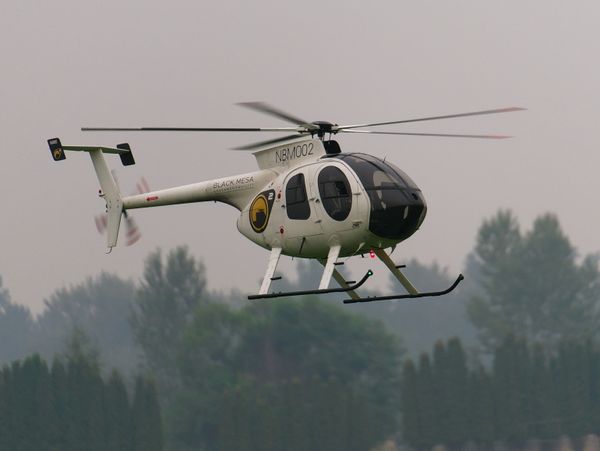
- I find I'm using a lot more pitch to hover this bird at that 1072 rpm at 40 lbs than Mesa at 34 lbs. I had expected that using Witte blades that are 895 x 46mm, with the extra length and a bit more chord, would make up the lift difference for the extra 6 lbs, but it seems not really.
Having said that, TIKI does fly very well... however... I'm always looking to improve things.
So, with my Jako PRO5000 going in for its 25hr overhaul, I had an opportunity to have them change the clutch gearing to bring me up to 1180rpm.
For my 'spirited' flying style, according to the Jako telemetry data, it has never come close to needing full power.
I think ChatGPT generated reasonably accurate numbers, with really the only significant variable being the blade NACA profile performance estimate.
Either way I enjoyed hashing through it all and feel the change will be an overall improvement.